
What survival meters are confirmed?
Oxygen and temperature are confirmed in official materials. Food, water, rest, and flight fuel also appear early in community footage — verify labels on your HUD.

Breathedge 2 oxygen guide: refill before every long salvage, manage temperature on cold runs, repair public stations, and turn back before soft death.
Gameplay — refill oxygen, craft tools, survive EVAs.
~7 min read
Breathedge 2 is a single-player space survival comedy from RedRuins Softworks (published by HypeTrain Digital), Early Access since August 31, 2026. This page is the Breathedge 2 oxygen guide with temperature and survival habits for Early Access Chapter 1: how life-support meters force short EVAs, mid-route refills, and suit upgrades before you overcommit to deep salvage. Verified September 3, 2026 · Buy on Steam.
Comedy writing will distract you. The meters will not. If a first-game Chapter 2 oxygen-station wiki page appears in search, ignore it — sequel systems and maps are not a copy-paste of that chapter numbering.
| Fact | Detail |
|---|---|
| Platform | Steam (Windows PC · Early Access) |
| Genre | Action · RPG · Simulation · Survival |
| Mode | Single-player |
| Confirmed survival | Oxygen · temperature (Steam / official materials) |
| Also on HUD early | Food · water · rest · flight / mobility fuel (community footage) |
| Refill patterns | Safe indoor volumes · repaired public oxygen stations (ice input observed) |
| Content scope | First EA chapter · story unfinished |
| Reviews | Very Positive (Steam snapshot — changes over time) |
| Not assumed here | Exact death penalties · final suit formulas · later-EA vehicle life support |
Oxygen is the hard stop. It drops while you float, fight, and panic-sprint; it climbs when you re-enter a pressurized safe pocket or stand in a working public oxygen volume. Learn those two refill classes before you memorize any POI name.
| Source | What players observe | Beginner use |
|---|---|---|
| Indoor safe pocket | Oxygen climbs after you duck back inside | Default refill after every short loop |
| Public oxygen station | Repair quest; ice input → local breathing volume | Midpoint refill once repaired |
| Consumables (e.g. oxygen worms / purified O₂) | Burst restores seen in early footage | Emergency only — do not replace station habits |
| Suit / tank upgrades | Longer bars and lower consumption when unlocked | Craft when materials allow — see equipment |
Early playthroughs call out oxygen on the vitals strip (often beside rest / eat / fly / drink). If the bar is not full when you exit, you are already borrowing return time. Habit: full tank or no launch — even for “just one crate.”
When the gauge hits roughly half on the way out, turn around. Loot behind you is still loot; loot past a zero bar is a reload. Exact percentages change with suit upgrades, so recalibrate after every tank craft instead of memorizing one magic number.
Consumable bursts and purified oxygen recipes appear later in the craft list — useful, but they train bad habits if you use them to ignore stations. Prefer infrastructure: home pocket + repaired public station + suit work on equipment.
Temperature is the quiet sister meter. Official materials confirm it; community titles about heating and “warming it up to go further” exist because cold zones punish long debris tours even when oxygen looks fine.
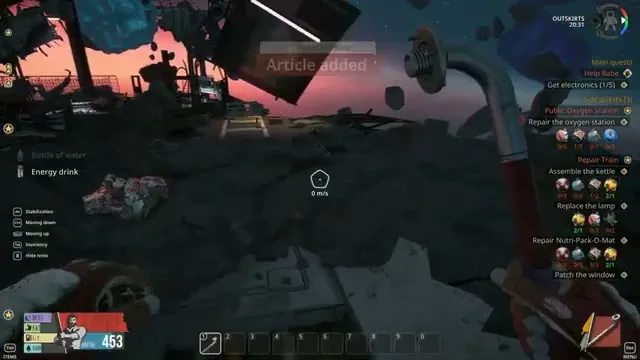
Until you unlock heating-related repairs or suit upgrades, treat cold pockets like oxygen sinks: enter, grab the marked part, leave. Lingering to “clear the whole wreck” while the temperature meter slides is how soft deaths look surprising.
Some early side repairs (kettle / station comfort bits) look like jokes and then quietly improve how long you can work a neighborhood. Do not skip local repair quests just because the dialogue is silly. When a patch adds clearer heat modules, this page should gain a version tag — until then, prioritize any craft that the encyclopedia labels as warming or insulation.
Deep suit module lists stay on equipment; this section only forces the habit: check temperature before you commit to a long outbound arc.
Use this as a verbal checklist at the airlock. It is shorter than a death, and it scales into Late Access when vehicles arrive — the meters stay, the checklist just gains fuel lines.
A full pack of spoiled snacks while aluminum sits on the floor is a failed prep. Bank scarce metals first (Babe’s purse is a common community stash tip — unverified capacity, confirm in your build), then leave. Storage habits also appear in the beginner guide.
Matched by build plan, shared topics, and guide progression — not random related links.
As soon as the local quest appears and you can feed it materials. A repaired public oxygen station turns a dead-end debris field into a loop with a midpoint breath. Early footage shows ice dropped into a working unit creating a volume where oxygen stops falling — that single interaction expands your safe radius more than another random crate run.
| Stage | Do this | Why |
|---|---|---|
| Quest unlocks | Accept public oxygen station repair beside starter objectives | Creates the first midpoint |
| Gather | Collect the listed parts / ice without leaving the neighborhood | Keeps O₂ risk low while you build infrastructure |
| Repair | Install, feed ice, confirm the breathing volume works | Validates the refill before you trust it |
| Expand | Plan EVAs that touch the station on the way home | Converts repair time into permanent range |
If you are choosing between a distant question mark and finishing the oxygen station kit, finish the station. Map tourism without refill midpoints is how Early Access Chapter 1 teaches the same lesson twice. Orient larger regions later via locations.
Coffinbots, ticket-booth turrets, and “hold still” enforcement bits are not only HP problems. Every chase, block, and panicked sprint is oxygen and flight fuel you planned to spend on loot.
Early footage shows players taking chip damage while looting because they never noticed the chase audio. If a fight starts past the halfway oxygen mark, disengage toward a known refill. Blocking and hitting may work on some foes; others are better fled. Exact enemy stats stay TBA — behavior beats DPS charts in EA.
Some areas have automatic defenses you can shut down from a rear terminal once you have the repair resources. If a zone keeps deleting your HP and oxygen, look for a computer path before you brute-force the loot. That is still survival planning, not a separate combat guide.
Use this decision table when greed argues with the gauge. It is the mid-page checkpoint that should change how you fly, not just how you feel.
| Situation | Decision | Why |
|---|---|---|
| Half tank outbound, no station ahead | Turn back now | Return burns the other half |
| Half tank, repaired station between you and home | Touch the station, then decide | Midpoint resets the math |
| Quest part visible 10 seconds away | Grab only if you still keep return margin | One part is not worth a soft death |
| Coffinbot aggro on half tank | Flee to refill, do not duel | Fights tax O₂ and HP together |
| Temperature sliding in a cold wreck | Leave with what you have | Cold + low O₂ stacks |
| Consumable oxygen in inventory | Use to reach a refill, not to keep exploring | Bursts buy escape, not tourism |
| New suit / tank just crafted | Recalibrate your half-tank landmark | Old distances are wrong now |
| You “almost” made it last time | Shorten the route — do not repeat the almost | Almost is a failed plan |
Stretch range with suit and tool upgrades on equipment, fund those crafts via resources and crafting, and only then push story distance with the walkthrough. First-hour orientation stays on the beginner guide.
Oxygen and temperature are confirmed in official materials. Food, water, rest, and flight fuel also appear early in community footage — verify labels on your HUD.
Return to a safe indoor volume, or repair and use a public oxygen station (ice-fed breathing volume observed in early play). Consumables are emergency backups.
Death and failure penalties are build-dependent in Early Access — treat exact penalties as TBA and play as if soft death costs time and position.
Oxygen ends runs faster, but cold exposure shortens safe salvage windows. Warming upgrades and local repairs expand range — watch both meters.
Usually no. Disengage to a refill. Combat drains the same tank you need for the flight home.
Not as a drop-in sequel walkthrough. Use them only as tone references; verify every step in Breathedge 2 EA Chapter 1.
Equipment for suit range, then beginner guide if your first-hour loop is still messy.
September 3, 2026
Matched by build plan, shared topics, and guide progression — not random related links.